

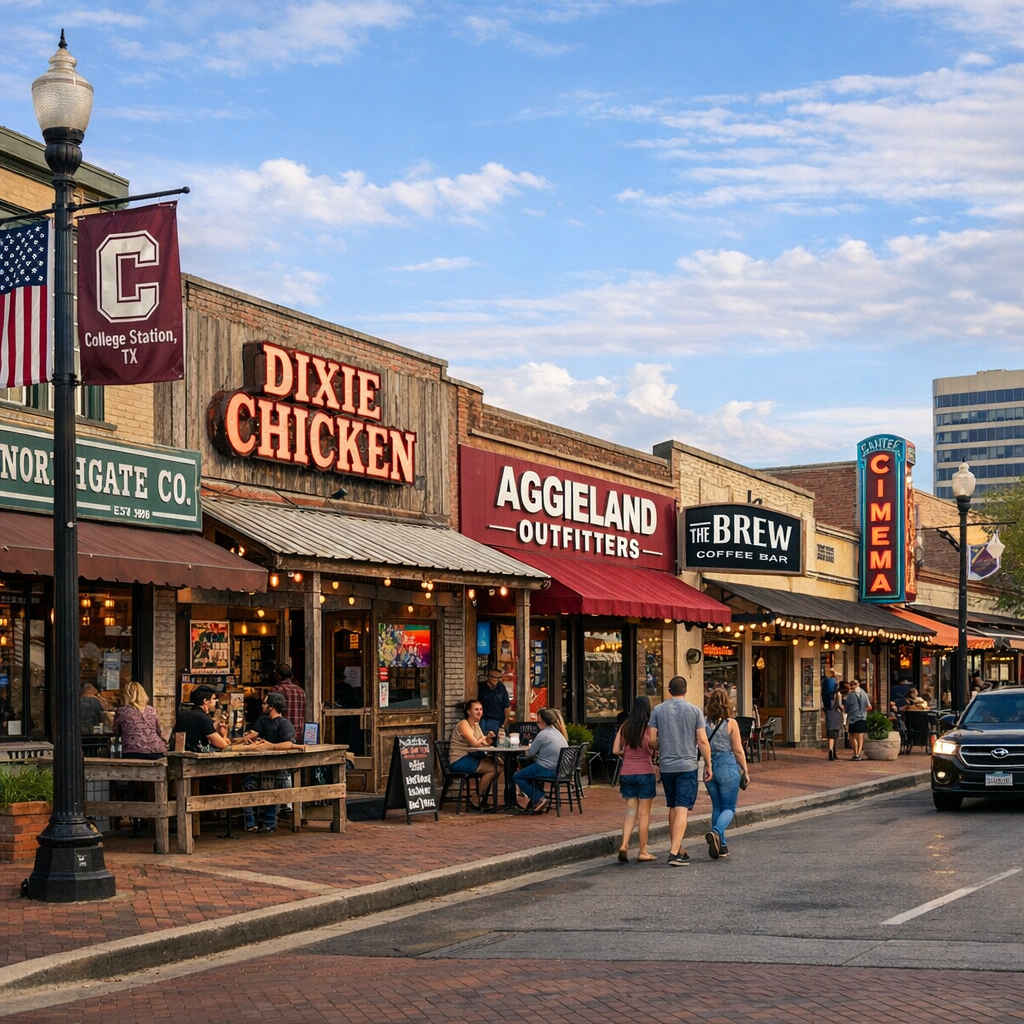
College Station’s economy is evolving. Anchored by the country’s major research universities and a growing population, local business dynamics reflect both long-standing strengths and emerging opportunities. Whether you’re running a shop, opening a startup, or hiring talent, here’s a grounded look at what’s shaping the local economy now—and how you can connect to the resources that help.
What Powers the Local Economy
First, education and healthcare remain pillars. Institutions like Texas A&M University and the RELLIS Campus provide hundreds of jobs for faculty, researchers, and support staff—making these sectors both stable and major drivers of economic activity. Education-and-health services account for roughly 17 % of the workforce, and similarly for job availability. Retail trade follows close behind with about 14-16 % of workers, and jobs exceed workers in that sector—reflecting steady demand from consumers and visitors. Emerging sectors like professional, scientific, and management services are gaining traction too. Many of these roles spin off from research partnerships, startups, and university innovation. These trends suggest that companies connected to knowledge work, research, or technical services may find fertile ground here. (Employment data drawn from multiple business reports and city planning documents.)
Labor, Wages, and Workforce Insights
The labor force in College Station-Bryan is youthful and educated, thanks largely to the universities. Mean wages are lower here than the national average for many sectors—but local cost-of-living keeps a lot of roles viable. For example, as of mid-2024, mean hourly earnings across all occupations are about $26.84, while categories like management or technical jobs can get well above $40-50 per hour depending on requirements. Less specialized roles—such as food service, retail, or maintenance—still dominate total employment numbers. (Key data from Occupational Employment reports.)
Spotlight on Taxable Sales Trends
Retail trade and hospitality are major engines here. Taxable sales in those sectors have shown consistent long-term growth—retail alone now makes up nearly half of the total sales tax base. Food service and accommodation contribute nearly 20 %. Though spending dipped during the pandemic, by 2023-24 we’re seeing growth rates return near pre-pandemic levels. For businesses in those spaces, that means recurring demand—but also competition and pressure to differentiate. (Sales-tax data across past decade for retail, hospitality, and related sectors.)
Support Systems for Entrepreneurs & Small Businesses
If you’re thinking of starting a business or scaling one, there’s a network here to plug into:
- Brazos Valley Small Business Development Center (SBDC): free advising, budgeting, help with financing, workshops.
- McFerrin Center for Entrepreneurship at Texas A&M: programs for students, community entrepreneurs, veterans; opportunities for prototyping, mentorship and business model validation.
- City initiatives: Grow College Station aggregates incentives, land/property info, planning resources to connect businesses with local economic strategy.
- Special programs: Workforce grants from the Texas Workforce Commission help businesses train or upskill staff, especially when you have fewer than 100 employees.
Challenges & Things to Watch
No community is without its trade-offs:
- Wage pressure and competition: As higher skilled roles increase, seeking and retaining talent in engineering, science, or technical fields can be hard, especially for smaller firms.
- Costs and affordability: Commercial rents, land, and operating costs are rising—especially near campus areas or high-traffic retail corridors. Planning ahead is essential.
- Sectors with worker shortages: Hospitality, arts & entertainment, and accommodation often report more jobs than available workers—especially during peak times like event or game weekends.
Opportunities for Growth & Strategy Tips
If you’re positioned to grow or launch in College Station, these strategies align well with current trends:
- Leverage the university’s innovation ecosystem—collaborate with Texas A&M or use resources at RELLIS; partner on research or offer services tailored to university needs.
- Differentiation in retail and hospitality—unique branding, local identity, event-driven experiences, social media engagement matter.
- Upskill and train—whether through state grants, community colleges, or internal training to meet demand in health, technology, or skilled trades.
- Use resource partners early—from business plan to financing, using SBDC, McFerrin Center, city incentive tools improves odds of success.
Overall, College Station offers a business climate that’s strong in community support, talent access, and steady demand—tempered by rising costs and workforce competition. Whether you’re hiring, investing, or just getting started, knowing this landscape helps build realistic plans that last.